


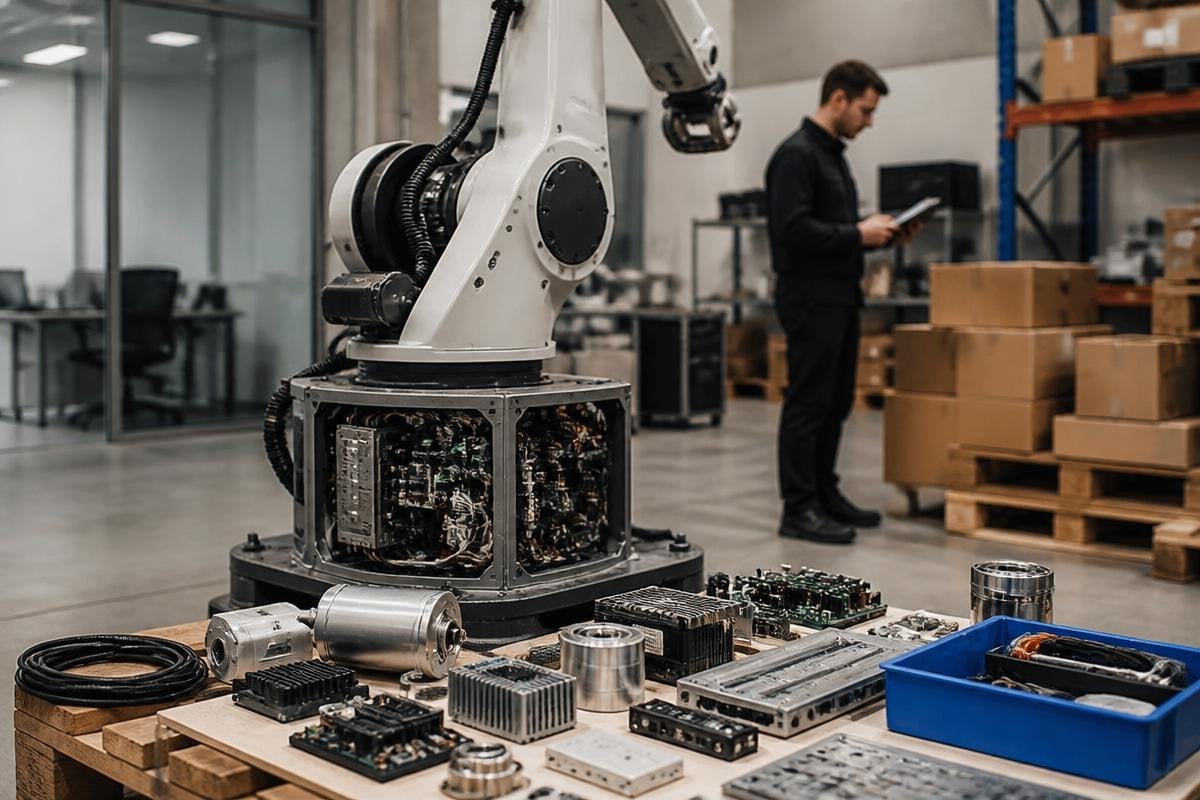
A robot can fail before it reaches a factory. A missing motor, delayed sensor, or changed battery cell can stop an entire machine program, even when the software works well. The supply chain now shapes which robots can ship, where they can run, and how much they cost.
- Parts matter: actuators, cameras, LiDAR, control boards, and batteries all affect the finished robot.
- Software depends on hardware: a sensor change can force new code, tests, and safety checks.
- Service decides uptime: spare parts and repair skills matter after installation.
The robot is a stack of suppliers
Most robots are assembled from parts made by different companies.
An autonomous mobile robot may need wheel motors, motor controllers, battery cells, cameras, LiDAR, wireless links, a computer, and a safety scanner. A robotic arm adds gearboxes, encoders, brakes, cables, and an end effector, the tool that touches the work.
Each part brings its own limits. A gearbox affects speed and lifting force. A camera affects object detection. A battery affects how long the robot can work before charging. The machine builder has to make these parts work together, then test the full system rather than each part in isolation.
That makes a small change expensive. If a supplier changes a camera module, the robot may need new mounting parts, new drivers, fresh calibration, and another safety review. The part may cost less, yet the engineering work can cost more.
Why supply gaps reach the factory floor
Factories need repeatable parts. A robot maker can’t plan a large delivery around a component that arrives in small batches or changes without notice. Production teams also need the same part months later for repairs, since a replacement that differs from the original can affect fit and software settings.
Batteries make this problem easy to see. Cells can differ in size, chemistry, connector layout, and charge limits. A new cell may fit inside the same battery case but need a different battery-management system, which checks temperature, voltage, and charge level.
The same issue applies to computing hardware. A control computer may run ROS 2, the software framework used by many robot developers, but its drivers still need to support the exact cameras, motors, and network links in the machine. A board swap can turn a working production model into a new test project.
Software cannot hide weak hardware
Robot makers often focus on autonomy, but the physical parts set the limits. Software can plan a route; it can’t give a motor more torque than the gearbox and battery can supply. It can identify a box; it can’t make a worn gripper hold one safely.
This is why factory buyers should ask for part continuity, repair plans, and test records. A demo can prove that one robot completed one task. It doesn’t prove that 50 machines will use the same parts for years.
Part continuity becomes a service question once the robot leaves the factory. Reports from Robot 24 can put the named supplier and deployed system beside the robot claim, giving you a starting point before the first repair call.
The service chain starts after delivery
The first installation is only the start of a robot’s cost. Operators need spare motors, cables, batteries, sensors, and gripper parts. They also need a person who can find whether a fault comes from hardware, wiring, calibration, or software.
The repair process matters most when a part is made by a single supplier. If that supplier stops making it, the robot maker may need to redesign the machine or hold a large stock of old parts. Both choices can raise the cost of keeping the fleet running.
I’d judge a robot company by its parts plan as much as its demo. A clear service manual and a stated replacement path tell you more than a polished video.
A practical check before you buy
Use these questions with the robot maker and each supplier:
- Part list: Which motors, sensors, computers, batteries, and gearboxes are inside the robot?
- Change notice: How much warning will you get before a part changes or disappears?
- Repair stock: Which spare parts are held locally, and how long will shipping take?
- Software support: Will a replacement sensor work with the current firmware and drivers?
- Service skills: Who can repair the robot, and what training does that person need?
A robotics supply chain earns its place when the machine keeps working after the first shipment. The next useful proof is a clear parts list, a repair plan, and evidence that the same design can reach the factory floor more than once.
